The wave guide Pan flute modeling
 Wind instruments
modeling A short characteristic of the Pan flute
The Pan flute modeling
Wind instruments
modeling A short characteristic of the Pan flute
The Pan flute modeling
Physical model
Quasi-physical model
Music compositions demonstrating the Pan flute sound
The wind instruments (aerophones)
produce the sound owing to the vibrating air in a cylinder.
As an air cylinder we understand a certain amount of air in the space
limited by the body of the instrument capable of vibratnig lengthwise.
The body of a wind instrument has a very prolonged shape (his length is
considerably bigger then the width and the thickness).
The instruments containing prolonged air cylinders, used as vibrator, are called pipes.
The following clasification of the wind instruments can be made.
We can distinguish the labial instruments (without mouthpiece -e.g. the flutes,
or with mouthpiece -e.g. block flute), the single reed instruments (the clarnets,
saxophones), the double reed instruments (the oboes, basoons), the limited reed instruments
(the trumpets, trombones, french horns, tubas, cornets) and the limited reed instruments
without mouthpiece (the human voice).

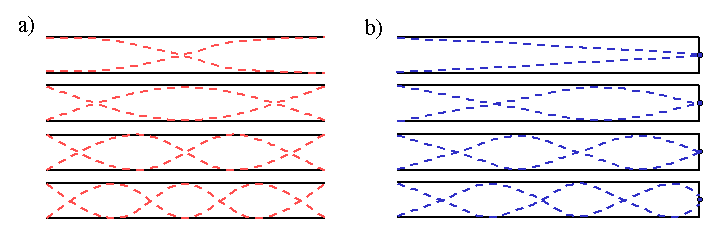
The waveguide modeling method, called the digital waveguide modeling method, was invented at the beginning of the 90's. The main assumption of the method is that the modeling is made by the use of a digital waveguide of the current propagation waves forming the standing wave in an instrument. The wave guide method allows many applications in the real time sound synthesis. Due to the method many wave-guide models of many instruments, not only wind, were invented.
 Return
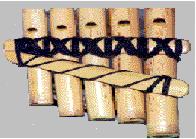
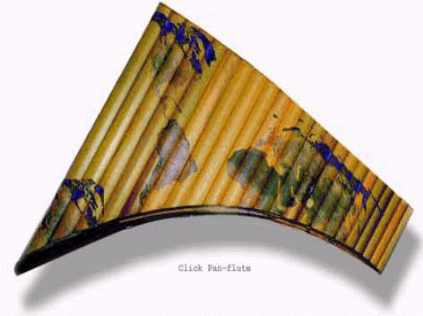
The Pan flute is a simple semi-open instrument. In its spectrum the odd harmonics dominate. A single tube resonator (the pipe) forms the only one pitch of the sound. The change of the air cylinder (tuning) can be performed by filling up the pipe e.g. with wax. The Pan flute is often made of bambus (or the other kind of tree) or bone, but there exist many different types of the instrument depending on the region of its origin. The hole through which the air is blowed in is ubicated on the pipe side. Each of the pipes is tuned to the succeeding sound pitches and the Pan flute is tuned to the chromatic scale. The octave range of an instrument is changing from 1.5 to 2 octaves.
|
|
|

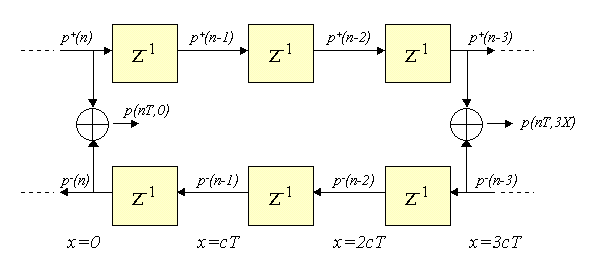
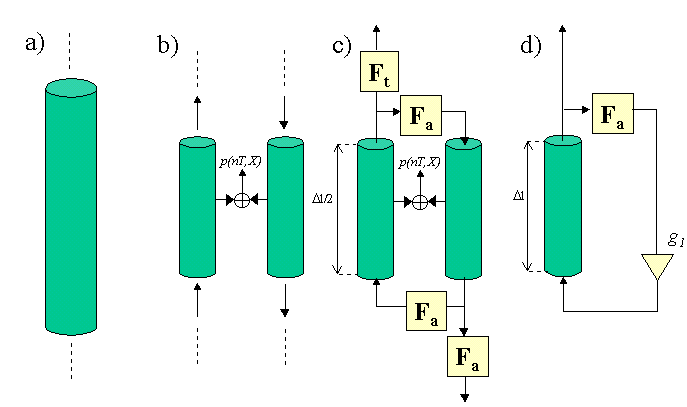
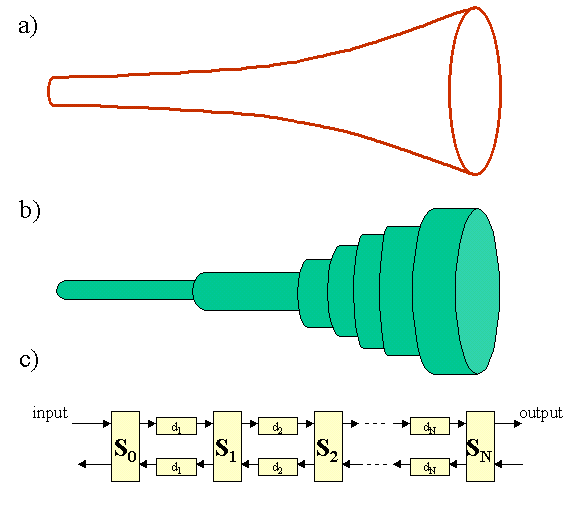
The idea of the wave-guide method is modeling, with the use of digital waveguide,
the propagation of current propagation waves forming the standing wave in an instrument.
Wave-guide modeling is related with the solution of the wave equation and leeds to
the base form of the digital waveguide of the current waves.
That is presented in the picture below.
| Krotka charakterystyka fletni Pana |
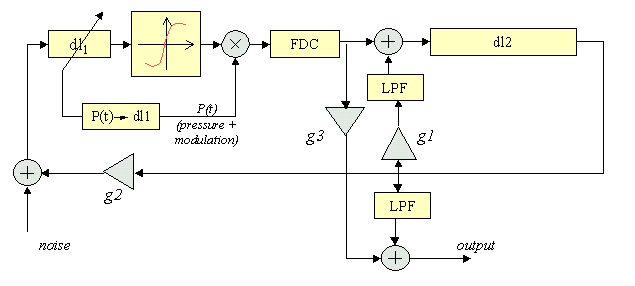
As It has been described before the physical model simulate aticulation effects (vibrato, tremolo) as they
can be done in a natural instrument. An instrument is simulated bu the use of two digital delay lines
(The lines are two times shorter than the instrument).
The place, when the effects origin are describde in the picture (the plice described
'pressure + modulation')
| Quasi-physical model |
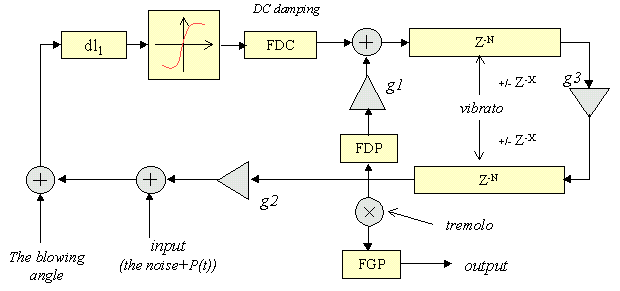
The quasi-physical model was invented by dr.sc.Slawomir Zielinski (Technical University of Gdansk. Poland).
The articulation is modelled in the simplificated way.
The tremolo effect (cyclic amplitude change) is simulated at the end of the wave-guide model.
The vibrato effect (cyclic freuency modulation) is performed by the modulation of the length of the digital delay line.
| Utwory muzyczne |