 Waveguide modeling - introduction
Digital waveguide model of the organ pipe
Results of experiments
Sound examples
Waveguide modeling is a new method of sound sythesis, whitch was originally proposed by Julius O. Smith III in 1992. In contrast to traditional methods wavegude modeling allows one flexible musical articulation. Main problem with the waveguide synthesis of building new models is complexity.
 Back
BackDigital waveguide synthesis was applied to the model of the organ pipe in 1997 by Sławomir K. Zielińki at Sound Engineering Department (Technical University of Gdansk, Faculty of Electronics, Telecommunications and Informatics). The digital waveguide model of the organ pipe is presented on the figure below.
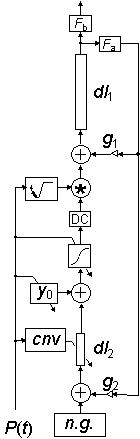
 - Lowpass filter
 - delay line modeling body of the pipe
 - delay line
 - scaler
 - scaler
 - filter
 - generator modeling the upper lip offset
 - conversion module
 - noise generator
This model is computationally efficient, so its implementation in real-time on a digital signal processor (DSP) was possible.
Preformed experiment proved that the digital waveguide model of the organ pipe allows one to have musical articulation of the same type as in classical organs. Namely, a small increase in the simulated pressure P(t) causes a small increase in pitch of the generated sound. If the simulated pressure P(t) is further increased, overblowing effects occur. The measured characteristic of the digital waveguide model is illustrated in figure below. This characteristic qualitatively agrees with the analog characteristic of real organ pipes.
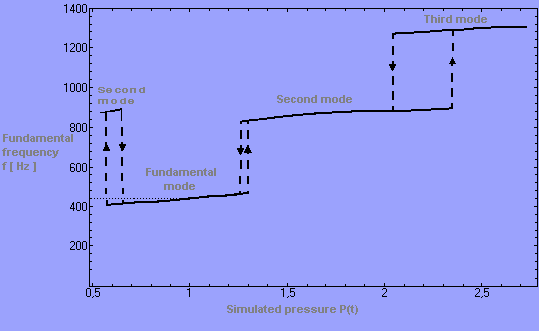
 This sound example was made through increasing and decreasing simulated pressure
J. S. Bach "Toccata in D-minor" ( wstęp ) ( mp3 143 kB )
F. Chopin "Prellude in c-minor" ( mp3 354 kB )
M. Kuropatwinski "Simple Theme" ( mp3 80 kB )
J.S. Bach "Menuet g-minor" ( mp3 364 kB )